Council, cascade and race
One request can use several models. Pick a plan by what you want to optimise.
| Plan | Models are asked | Good for | Answers get |
|---|---|---|---|
| Fallback chain | one at a time, until one answers | surviving outages and rate limits | - |
| Council | all at once, blended | fewer confident mistakes | agreement |
| Cascade | cheapest first, escalating only unsure questions | cost | answered_by |
| Race | all at once, first valid answer wins | latency | - |
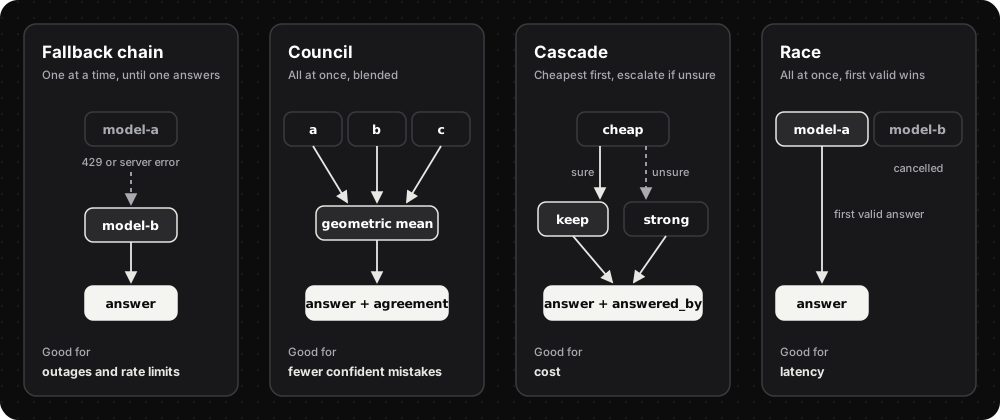
Fallback chain
Section titled “Fallback chain”client.decide(state, questions, model=["model-a", "model-b"])If a model returns 429 or a server error, the next one takes over. The response’s model says
which one answered.
Council
Section titled “Council”d = client.decide(state, questions, council=["model-a", "model-b", "model-c"])d["team"].agreement # share of members whose top answer matches the council's2 to 5 models answer concurrently, and their probabilities are blended by geometric mean. Where members disagree, confidence drops, which is exactly what you want: disagreement is a signal to look closer. A member that fails is left out.
HTTP: "model": {"council": ["model-a", "model-b"]}.
Cascade
Section titled “Cascade”d = client.decide(state, questions, cascade=["free-model", "strong-model"], escalate_below=0.8)d["team"].answered_by # the model that gave the final answerThe cheapest model answers first. Only the questions whose confidence is below
escalate_below (default 0.8) go to the next model; confident answers stand. If the stronger
model fails, the cheaper answers are kept. When the cheap model is sure, the strong model is never
called.
HTTP: "model": {"cascade": ["free-model", "strong-model"], "escalate_below": 0.8}.
client.decide(state, questions, race=["model-a", "model-b"])All models are asked at once, the first valid answer wins, and the others are cancelled. This cuts slow outliers on shared providers, at the cost of one call per model.
HTTP: "model": {"race": ["model-a", "model-b"]}.
On the command line
Section titled “On the command line”curva bench and curva map take the same plans:
curva bench --council model-a,model-bcurva map in.jsonl -q questions.json -o out.jsonl --cascade free-model,strong-model --escalate-below 0.8curva bench --race model-a,model-bUse only one of council, cascade or race per request.


Documentation for everything Tarkova makes.
© 2026 Tarkova Private Limited.